1
Thinking
How science reasons — and how not to fool yourself
بصيرة
ba·si·ra · Arabic · the faculty of seeing truly; discernment
Nine weeks. Cancer biology, real public data, the statistics that go with it — and the reasoning that decides whether any of it means anything. Every student finishes by designing and running a study of their own.
Chapter 2 · Figure 2.8
One of these charts is a lie, and it is the kind of lie careful people tell by accident. Start the axis at 98 and D looks twice B; start it at zero and the groups are nearly identical.
We do not describe this to students. We do it to them, and then show them how. That is roughly what the whole programme feels like.
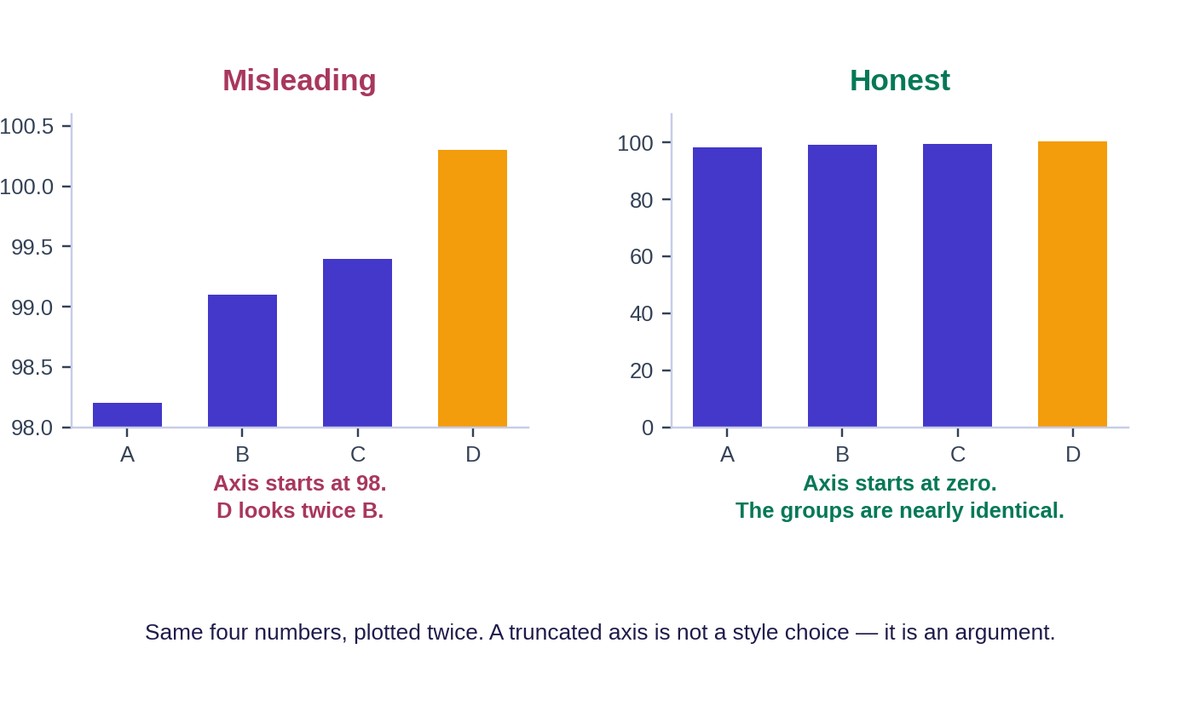
From Chapter 2 · Practice
What makes this different
You can learn to run an analysis from a tutorial in an afternoon. Knowing whether to believe the answer takes longer — and it decides whether your work is worth anything at all.
01
The first chapter contains no biology whatsoever. It is about how a claim earns belief, the three things a p-value is not, and why the result you are most excited about is the one that most needs checking.
02
TCGA, DepMap, GEO — the same datasets behind published cancer research. Handled with real care, because a misread unit will ruin an analysis and never once raise an error.
03
By week five you are reading papers the way a reviewer does, hunting for the claim everybody cites and nobody has checked. Find one, and the rest of the programme turns it into something testable.
The curriculum
All of it published openly — free to read, free to share, free to teach from, and open to correction. Every figure was drawn for the exact point it makes. Read it before you apply, teach yourself from it, or send it to someone who needs it.
How science reasons — and how not to fool yourself
Integrity, collaboration, and saying it straight
What cancer is, and how a cell powers and builds itself
What data exists, and how to handle it without breaking it
The statistics and the code, as a reference you return to
Now go and find a question of your own
The first cohort
From the first cohort, after the programme finished.
“
The sessions were well organised, the material was clear and easy to follow, and they were always patient, supportive, and willing to help whenever we had questions.
“
A heartfelt thank you to the founders and instructors for generously sharing their expertise and for creating such a supportive environment for aspiring researchers.
“
Grateful to have been part of the first Basira cohort. I’m proud to have been part of this journey and excited to see Basira continue to grow.
Who it is for
You need curiosity, four hours a week, and a willingness to be wrong in public — which is the real entry requirement for science.
That you are studying something scientific and can read English. That is the whole list.
Nothing. The programme, the materials, the software and the data are all free.
A pre-registered study you designed, ran, and can defend in front of a room.